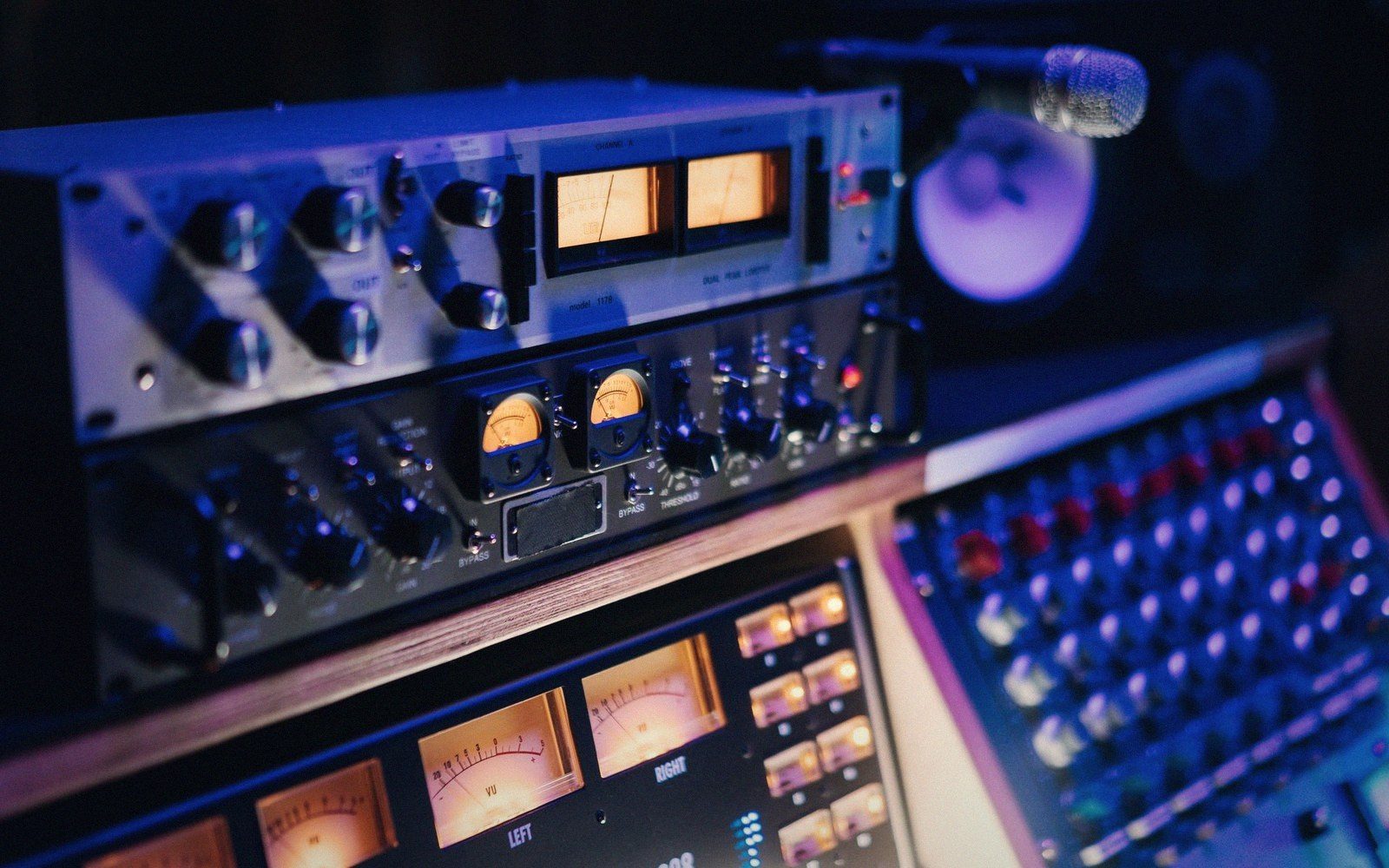
Analogue Drum Machines Were Never the Point
The fetish for hardware in psytrance production mistakes the medium for the message — this genre was born digital and sounds better for it.
Photo: Egor Komarov / Pexels
SUB / 01The Myth Has a Sales Pitch Attached
Walk through any production forum thread about psytrance kicks and you will eventually hit the same move: someone invokes the TR-909, someone else mentions the Jomox MBase, and a third person implies that the genre's warmth — its substance, its floor impact — flows from components built before the DAW era. It is a persuasive mythology, partly because hardware fetishism is genuinely pleasurable, and partly because it attaches prestige to expensive equipment. It is also largely wrong.
Psytrance was not reverse-engineered from analogue drum machines. It was engineered, largely from scratch, using digital tools — and that distinction matters enormously for anyone making decisions in the studio right now.
The genre's foundational production era ran through the 1990s on software and digital samplers. The Akai S950, the S3000, the S2000: these were the machines that held the kicks of early Infected Mushroom, of Astral Projection, of the Israeli and German studio lineages that defined how a psytrance kick behaved. Not analogue synthesis — digital playback of carefully crafted WAV files, run through mixing boards and outboard compression, then mastered hard. The warmth listeners retrospectively attribute to the analogue signal chain is more accurately the sound of 20-bit converters, tape-saturated mixdowns and rooms. Take those same kicks into a clean modern chain and the analogue-versus-digital argument mostly evaporates.
SUB / 02What the Kick Actually Is
The psytrance kick has three jobs: it clicks, it punches, and it moves air. The click is a transient — a high-frequency spike that cuts through even a saturated mix and gives DJs a beat to mix on. The punch is the body, typically a short sine-wave tail pitched between 50 and 80 Hz. The air-moving is almost entirely a room and rig problem: no drum machine, analogue or digital, changes the physics of a subwoofer cabinet. Sub bass is a room problem, not a synth problem — and no amount of hardware signal path changes what happens when a 20 Hz wave hits a concrete wall.
What analogue drum machines actually offer is harmonic saturation in the midrange body of the kick — a slightly rougher, more complex waveform than a clean sine tail. That is a real difference. It is not, however, the difference between a working floor kick and a broken one. It is a tonal preference at most, one that can be approximated with a single distortion stage on any digital oscillator. The producers who swear by their hardware units are often hearing the result of a particular gain structure, not the presence of analogue transistors in the signal path.
The anatomy of a kick in psytrance was being refined in software environments well before the current hardware revival made it fashionable to talk otherwise. Cubase VST, Logic Audio on vintage Mac hardware, Rebirth running on a laptop — these were the actual tools. If anything, the digital origin explains why psytrance kicks are so precisely engineered: you can tune a sample to the cent, time a tail to the millisecond, and layer transients without phase drift. An analogue machine is harder to tune, harder to recall, and harder to clone across a studio session. Those are not virtues; they are constraints that producers worked around or simply ignored by printing a WAV and moving on.
SUB / 03Why the Fetish Persists
The analogue nostalgia in psytrance production circles is not purely irrational. Part of it is the same force that drives vinyl and tape enthusiasm in every genre: the pleasure of working with objects that have physical resistance, that push back, that introduce variation you didn't fully control. There is genuine creative value in that. A Jomox unit being driven slightly hot will colour the sound in ways that no plugin emulation perfectly replicates. None of that means the emulations are worse for psytrance specifically — it means they're different.
The more troubling part of the nostalgia is its gatekeeping function. Gear lists in production discussions are often social signals before they are technical ones. Saying you made your kick with a hardware unit positions you in a lineage; saying you made it in a modern DAW with a synthesiser plugin puts you in a category some people call bedroom producer with audible contempt. The music does not care. The floor at 4am does not care. What a floor at that hour requires is a kick that is punchy, well-timed, and at appropriate volume — none of which are properties that flow from the presence or absence of analogue circuitry.
Psytrance has always been a forward-looking genre technically, even when its artwork and mythology reach backward to Goa beaches and forest fires. The producers who actually moved the sound forward — who tightened the tail, sharpened the sidechain gate, pushed the tempo logic to its current precision — were mostly working in the box. Celebrating hardware in retrospect is fine as history. Prescribing it as a production requirement is nostalgia dressed up as expertise, and it should be treated accordingly.